1 Introduction to Point Processes
1.1 What is spatial data?
Spatial statistics is the branch of statistics concerned with the analysis and modelling of data that are associated with locations in space.
In many applications, the primary object of interest is not a continuous surface, or a time series, but rather a collection of events, occurring at random locations in space.
Examples include:
- the locations of trees in a forest
- the positions of disease cases in a region
- the epicenters of earthquakes
- the positions of galaxies in the universe
In each of these settings, the data consist of a set of points in a spatial domain \(W \subset \mathbb{R}^d\).
1.2 From deterministic points to randomness
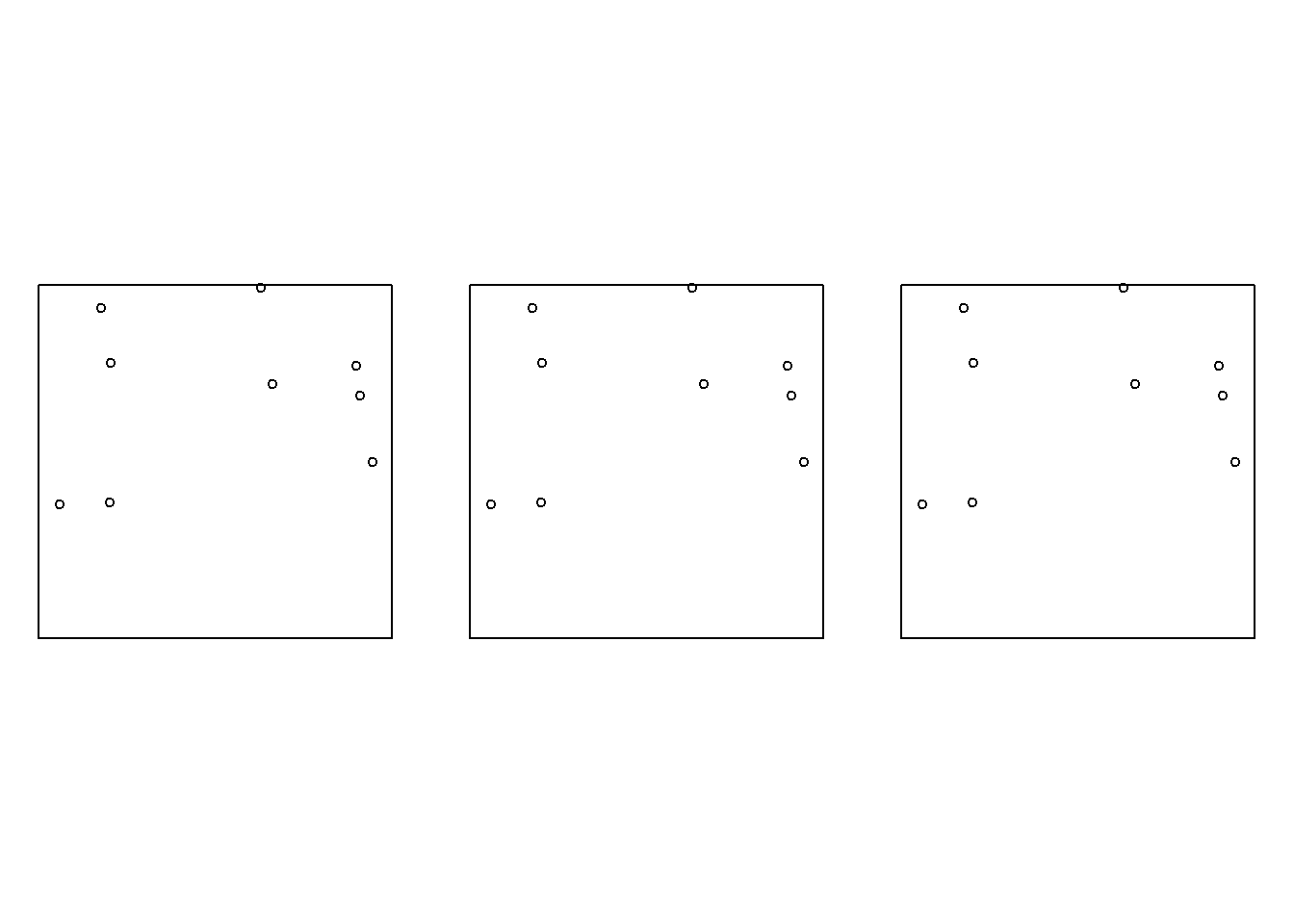
If the locations of events were fixed and deterministic, standard geometric or descriptive tools would suffice. For example, the following data, for whose points locations remain fixed, would not require any special tools:
However in most real world settings, the locations exhibit random variation. An example is might look like the following:
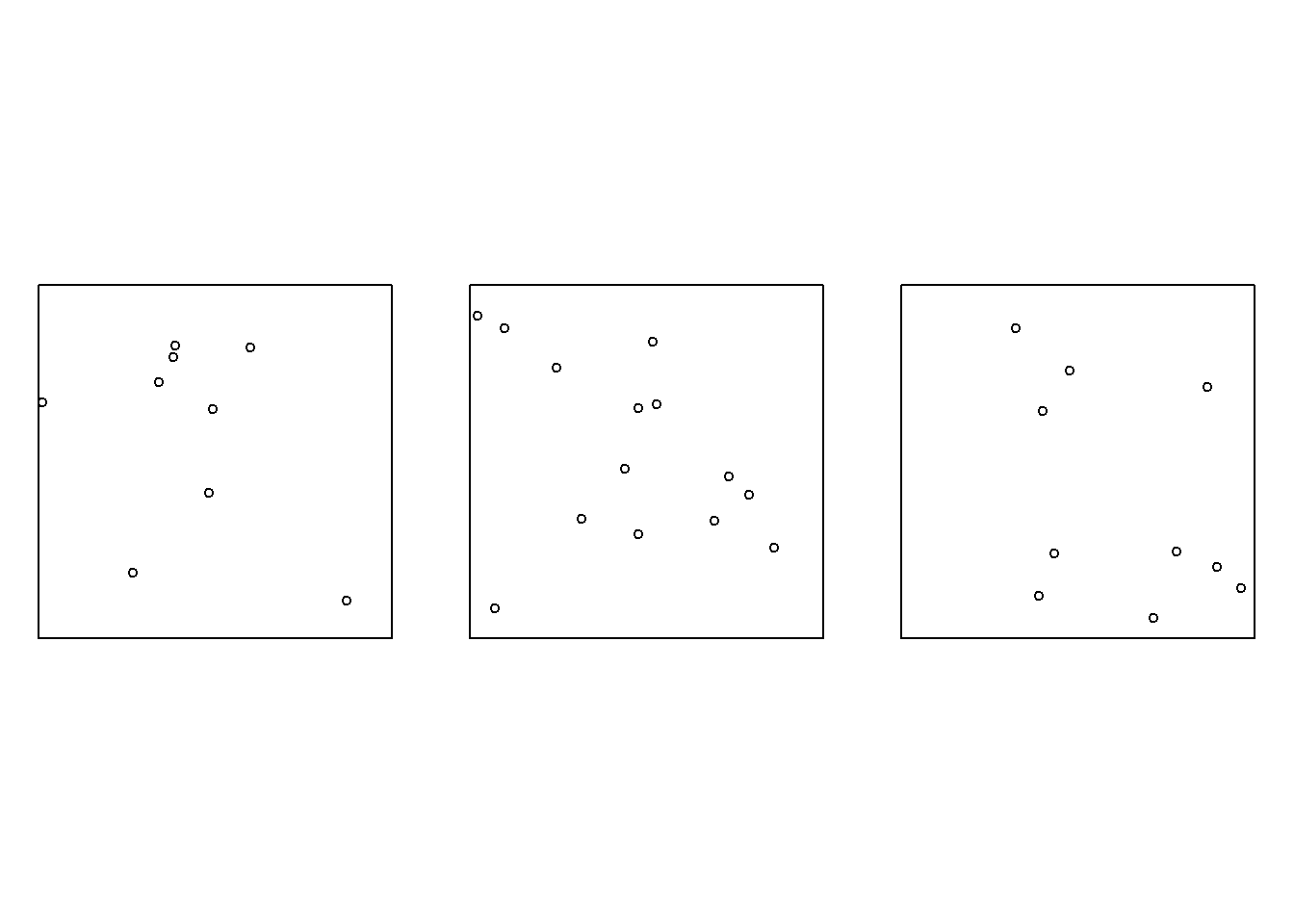
This randomness raises fundamental questions:
- How many events occur in a region?
- Are events evenly clustered, or regularly spaced?
- How does the density of events vary across space?
To answer these questions, we require a probabilistic model for random point patterns.
1.3 Point processes as random mechanisms
A point process can is a mathematical object used to describe random collections of points in space.
[What is the informal definition in the spatstat book again?]
Informally, a point process can be thought of as a random mechanism that generates a set of locations:
\[ X = \{x_1, x_2, \dots, x_n\} \subset . \]
Unlike the usual random variables, which take values in \(\mathbb{R}\), a point process takes values in the space of finite subsets of \(W\).
1.4 Why not just use densities?
A question you might ask is, why not model the data using a probability density over space?
The key issue is that a pattern contains two distinct sources of randomness:
- How many points occur (the count)
- Where those points are located
A standard density function cannot simultaneously describe both of these components.
Point processes explicitly account for both:
- the number of points in a region
- the spatial arrangement of those points
1.5 First glimpse of structure
Even at this informal level, we can begin to distinguish between different types of spatial behavior.
- Complete spatial randomness (CSR) - Points occur independently and uniformly across space.
- Clustering - Points tend to appear in groups.
- Regularity (inhibition) - Points tend to repel each other.
Understanding and quantifying these behaviors is a central goal in spatial statistics.
1.6 Roadmap
In the chapters that follow, we will develop the mathematical framework needed to study point processes in detail.
We then develop tools to describe their structure, including:
- first-order properties (intensity)
- second-order properties (pair-correlation and \(K\)-function)
These concepts will ultimately allow us to study more complex models, such as Cox processes and, in particular, log-Gaussian Cox processes (LGCPs).