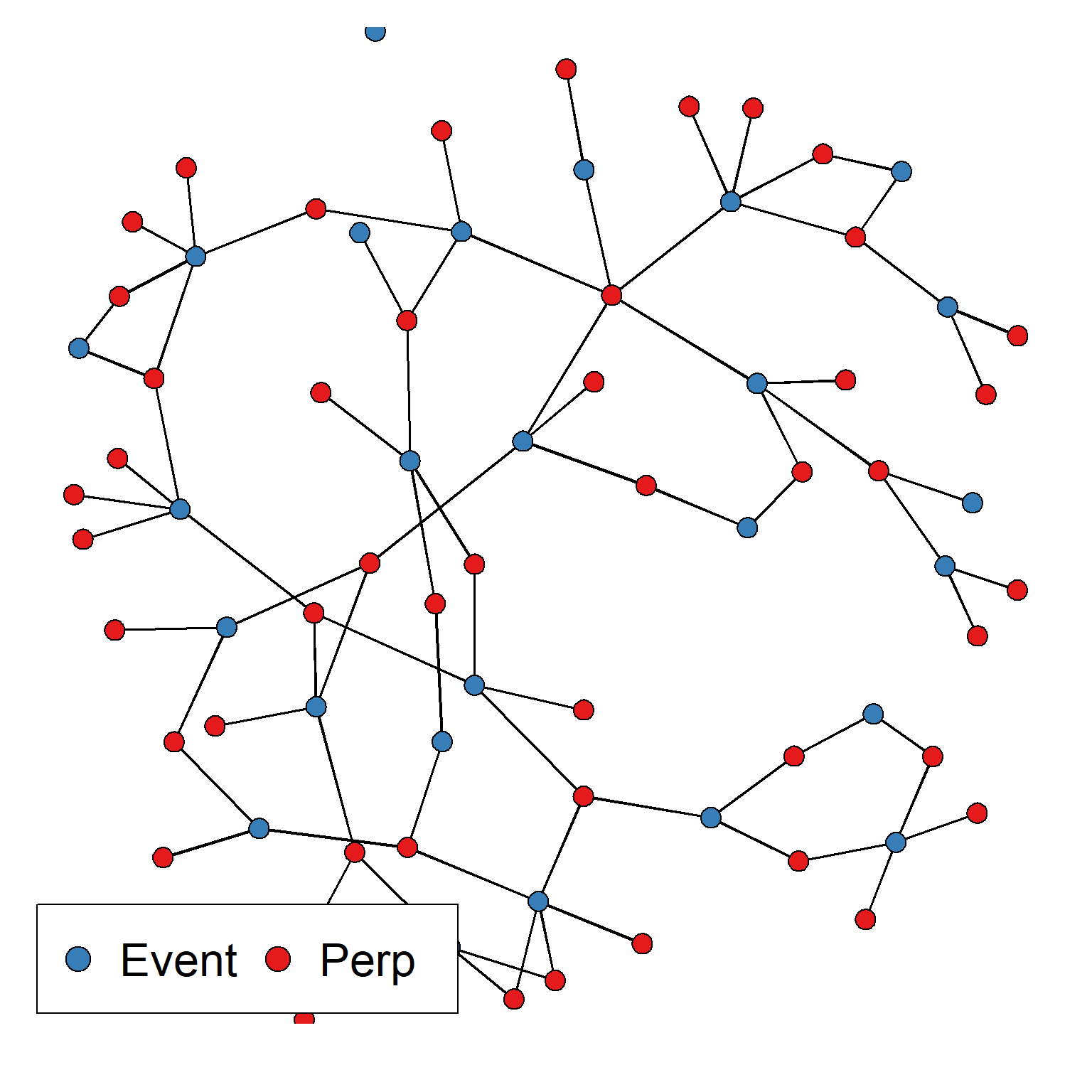
The CS-Bipartite kernel extends the CS (“change-statistic”) kernel to bipartite networks, where nodes belong to two disjoint sets (say Part A and Part B) and edges may only occur across parts (A–B).
As in the CS kernel, attachment decisions are driven by ERGM-style change statistics, rather than by degree weighting.
At each event time \(t\):
A random number of new nodes arrives: \[
M_t \sim \text{Poisson}(\lambda_{\text{node}}),
\] where \(\lambda_{\text{node}}\) is controlled by node_lambda.
Each arriving node is assigned to one of the two bipartite parts (according to the internal sampling mechanism in the simulator).
Let \(V_A(t^-)\) and \(V_B(t^-)\) be the existing nodes in Parts A and B immediately before time \(t\). Let \(N_A(t)\) and \(N_B(t)\) be the sets of new nodes arriving into Parts A and B at time \(t\).
The candidate edge set consists of all possible cross-part new–old edges: \[
\{(u, v): u \in N_A(t),\, v \in V_B(t^-)\}
\;\cup\;
\{(u, v): u \in N_B(t),\, v \in V_A(t^-)\}.
\]
Optionally, the candidate set may be truncated (via the truncation argument) to reduce computational cost by limiting how many old nodes each new node is allowed to consider.
For each candidate edge \((u,v)\), a vector of bipartite change statistics \[
C_{uv}(t)
\] is computed from the current bipartite network using the user-specified ERGM-style formula (via computeChangeStats()).
These are converted into baseline edge probabilities using a logistic link: \[
p^{(0)}_{uv}(t) = \text{logit}^{-1}\!\left(C_{uv}(t)^\top \theta\right).
\]
As in the other kernels, an aging / recency adjustment is then applied to down-weight older target nodes: \[
p_{uv}(t) = p^{(0)}_{uv}(t)\,\exp\!\big(-\beta_{\text{edges}}\cdot \text{age}_v(t)\big),
\] where \(\text{age}_v(t) = t - t_v\) is computed from the stored node arrival time.
Each candidate edge is then treated as an independent Bernoulli trial, so the mark probability is a product of Bernoulli terms over the bipartite candidate edge set.
Data Expectations
To use the CS-Bipartite kernel, your observed events must represent a bipartite growth process, meaning:
Every node belongs to exactly one of two parts (A or B).
Each event time may introduce zero or more new nodes.
Any edges observed at an event must connect a new node to an already-existing node in the opposite part.
In particular, the current CS-Bipartite implementation assumes:
No within-part edges (no A–A or B–B edges).
No old–old edges (edges cannot form between two already-existing nodes).
No new–new edges (edges cannot form between two nodes arriving at the same event time).
No self-loops, and no duplicate edges within a single event.
If your data contains cross-part edges forming between two already-existing nodes (e.g. repeated interactions between the same two agents over time), then the CS-Bipartite kernel is not an appropriate mark model without extending the mark space / PMF.
Make sure to specify the transformation setting for the CS parameters.
Ideally will default to correct value, but want to discuss how we are implementing the arguments, because lowk I like the old way of passing CS_params better.